
Your needs, this model
Does it fit your priorities?
Can pressure cooking handle one supplied cup of brown rice?
Yes. Brown accepts 1–4 supplied cups on this pressure-IH model.
Explore this need in the finder →Can it make half a supplied cup of steel cut oats?
Yes. Its dedicated oatmeal range is 0.5–2.5 supplied cups.
Explore this need in the finder →Can I require a supplied steaming tray with pressure cooking?
No. A steaming tray is not included.
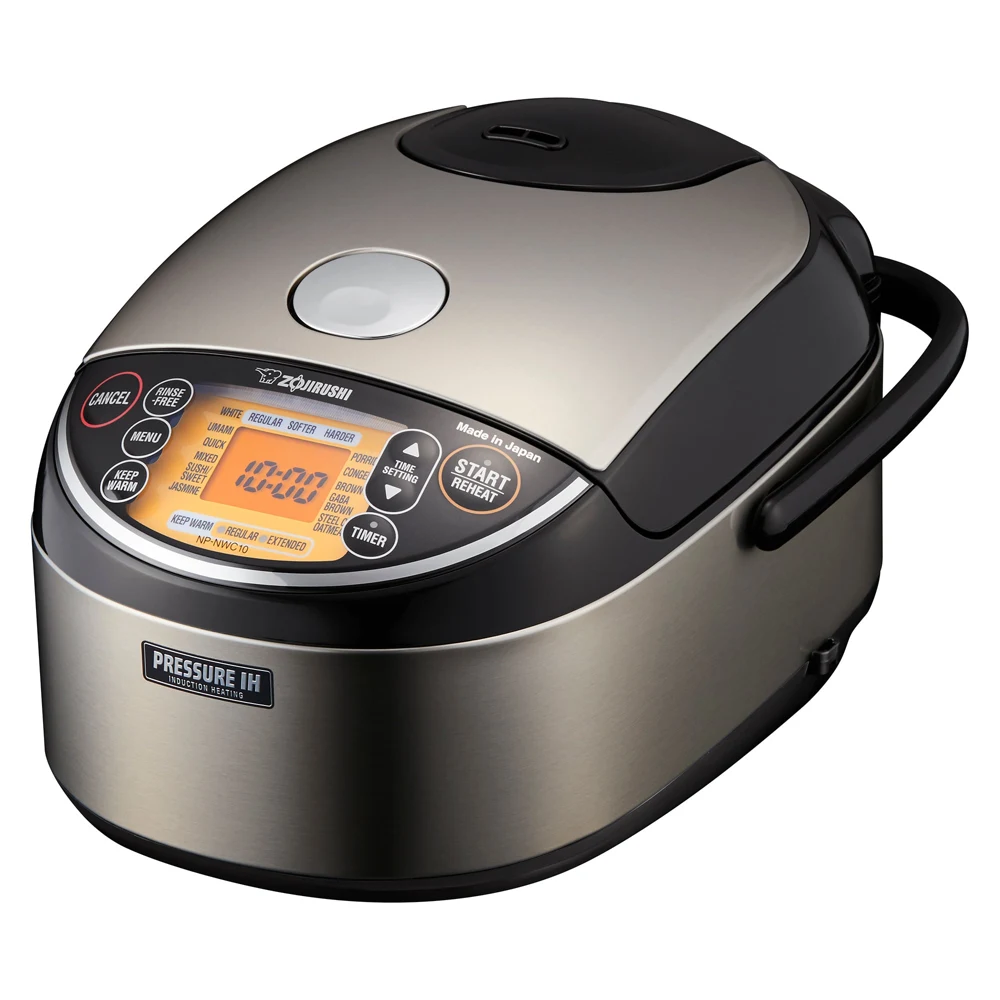
Explore this need in the finder →The NP-NWC10 combines pressure and induction with white-rice texture choices, Jasmine, two porridge styles and steel cut oatmeal. It is worth considering when rice is a regular meal component and you want pressure-assisted cooking without the My Rice feedback routine of the NW-JEC series. Its half-cup white-rice minimum is useful; its one-cup brown-rice minimum is equally important.
Use the right cup and grain range
The clear supplied cup measures approximately 180 mL. For ordinary short or medium grain white rice, the NP-NWC10 accepts 0.5–5.5 supplied cups before cooking. Jasmine has the same range. Brown and GABA Brown accept 1–4. If you normally cook half a supplied cup of brown rice, this is already the wrong capacity range, even though the white-rice minimum appears suitable.
The manual also supplies a green cup specifically for rinse-free white rice. Its volume differs from the clear cup, while the numerical menu limits are expressed using the appropriate measure. Keep the two cups identifiable and follow the rinse-free instructions. Substituting an ordinary US cup, or treating both supplied cups as interchangeable, undermines the relationship between dry rice and the pan's water lines.
Mixed rice accepts 0.5–4 supplied cups and porridge 0.5–1.5. Jasmine congee is limited to 0.5–1. A breakfast of steel cut oatmeal has a separate 0.5–2.5-cup range. These are dry ingredient quantities, not bowls of finished food. Plan the actual grain first, then decide whether this pan is large enough.
Pressure control with familiar choices
The cooker selects pressure levels according to the menu rather than asking you to manage a general pressure-cooking recipe. White rice offers regular, softer and harder selections. Umami extends the preparation process, while Quick provides another scheduling option. The useful ownership question is whether you will choose among these routines consistently. Merely having more settings does not tell you which result your household will prefer.
The 1.7 mm inner pan has a platinum-infused nonstick surface. This is a coated cooking vessel, not a bare stainless steel pot. Protect the surface with suitable utensils and follow the washing instructions. A coated pan needs gentle handling even when the surrounding appliance has a substantial stainless-colored body.
Breakfast and staggered meals
Separate short or medium grain porridge and Jasmine congee programs are useful if your household cooks both styles. They use different rice and water instructions, so one should not be treated as an alternate label for the other. The oatmeal program also gives a direct route for steel cut oats. That makes the NWC10 more relevant to a breakfast routine than a model whose menu only mentions rice porridge.
Automatic Keep Warm, extended Keep Warm and reheating provide serving controls. Use them within the recipe restrictions rather than assuming every cooked grain or mixed dish can be held for the same period. A timer similarly needs enough lead time for the selected menu. An extended brown-rice routine will not become a quick dinner just because a finish time is entered.
The lid needs deliberate care
The manual specifically identifies the pressure-control valve, safety valve and inner-lid filter. The filter is to be detached and cleaned after every use. This is a practical distinction from buying a simple switch cooker: budget a few minutes to inspect the lid components, not just rinse the inner pan. Follow the manufacturer's instructions for checking obstructions, and do not disassemble components that it says to leave intact.
The closed size is approximately 10.125 inches wide, 15.375 deep and 8.625 high. The manual lists about 16.375 inches with the lid open. Check the depth as well as the height on a narrow counter. The supplied equipment covers measuring and serving rice; a separate steaming basket is not included.
Our recommendation
Choose the NWC10 for pressure-IH rice cooking in moderate quantities, including one-to-four-cup brown-rice meals and small oatmeal batches. The NWC18 increases capacity but also raises the brown-rice and oatmeal minimums. The JEC10 adds feedback-based texture adjustment. If a supplied tray and dedicated quinoa menu matter more than pressure, the QAC10 addresses a different routine.
Sources: Zojirushi US product page and NP-NWC10/18 instructions.
Key details at a glance
| Capacity and cup basis | 180mL supplied uncooked cup; white 0.5–5.5, brown 1–4; cooked yield varies. |
|---|---|
| Closed width | 10.12 in |
| Closed depth | 15.38 in |
| Closed height | 8.62 in |
| Heating and controls | induction |
| Delay timer | Yes |
| Automatic Keep Warm | Yes |
| Supplied steaming basket/tray | No |
| GABA Brown program | Yes |
| Pressure-assisted rice cooking | Yes |
| My Rice feedback adjustment | No |
| Approximate height with lid open | 16.38 in |
| Control arrangement | menu |
| Timer arrangement | clock |
Use the exact model’s instructions for operating limits, supplied equipment and version differences.
Sources for this assessment
Put your batch and serving needs together.
Choose the dry amount, grain program and useful accessories.