
Your needs, this model
Does it fit your priorities?
Can I cook two supplied dry cups of white rice below the tacook side dish?
Yes. The exact A10U combined method permits one to two supplied cups, using the prescribed cookbook quantities above.
Explore this need in the finder →Can I use three cups below the plate because this is a 5.5-cup rice cooker?
No. Three fits rice-only cooking but exceeds the two-cup combined maximum.
Explore this need in the finder →Does the microcomputer provide a delay timer?
No. A10U has direct cooking keys without a clock or finish timer.
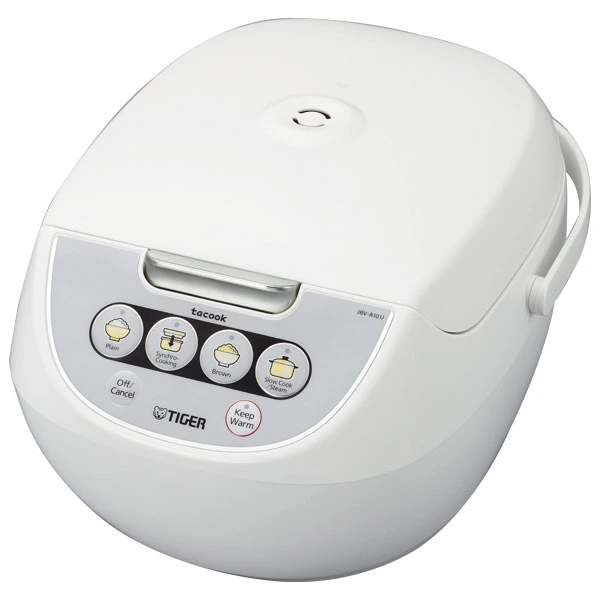
Explore this need in the finder →The Tiger JBV-A10U makes sense when the useful extra feature is a small rice-and-side-dish dinner rather than a long menu of rice textures. Its supplied tacook plate sits above the rice, and the dedicated Synchro-Cooking button runs the combined meal. The important qualification is quantity: this 5.5-cup cooker supports only one to two supplied cups of dry rice when that plate is in use.
Choose it around the smaller meal
A household regularly cooking one or two rice cups can use the A10U's combined mode without moving to a larger machine. One level supplied cup is approximately 180mL, or about 150g of white rice. It is a dry-rice measure, not a US measuring cup and not the amount served after cooking. Cooked yield changes with the grain and preparation.
Rice-only capacity is broader. The exact US instructions specify one to 5.5 supplied cups for white rice and one to 3.5 cups for brown rice. A five-cup white-rice load therefore fits the rice-only method but cannot fit beneath the cooking plate. For four cups of rice with a side dish, the larger JBV-A18U is the relevant sibling; for three cups, the small model's extra rice-only space still does not authorize a larger combined load.
The rice type changes which button to press
The simple control panel has separate Plain, Brown, Synchro-Cooking and Slow Cook/Steam controls. Plain is the manual's route for long-grain white rice. For short-grain white rice without a side dish, Tiger directs the user to Synchro-Cooking but with the plate removed, using the Plain water markings. That rice-only arrangement retains the full one-to-5.5-cup range.
This is a useful distinction for someone who expects “Plain” to mean every kind of white rice. Learn the button and water-line combination for the rice actually kept in the pantry. The manual's estimated cooking periods also depend on that choice and the amount, so avoid building a meal plan around one advertised time for every rice type.
Brown rice gets its own button and water scale. Its 3.5-cup ceiling is smaller than the white-rice ceiling, and the manual recommends a separate one-to-two-hour soak for brown rice. It does not give this model a GABA Brown program. Someone choosing specifically for that named program should compare the Zojirushi NP-HCC10 instead of treating any Brown button as equivalent.
What tacook adds to an ordinary dinner
The plate is useful for the dishes prescribed in the supplied cookbook. Prepare those quantities, spread the ingredients as directed and use the combined rice range. It is not a second open-ended cooking pot: stacking extra food or adding a large quantity of sauce can change how the meal cooks. The manual specifically cautions against substituting unlisted recipes or exceeding their ingredient amounts.
Once cooking finishes, lift out the hot plate carefully and loosen the rice. Do not leave the plate or its food inside during Keep Warm, and do not return it to the pot after removal. This makes tacook a prepare-and-serve arrangement. It is less suitable for a household expecting the whole dinner, including its side dish, to remain together in the cooker for hours.
Simple controls have real limits
The A10U has no finish timer. Its microcomputer controls cooking, but that does not provide the clock and two stored completion times found on the JBV-S10U. Choose the S if scheduled rice is important, while checking its menu-specific timer restrictions too.
Slow Cook/Steam is another separate routine. When steaming without rice, follow the manual's water amount, check the prescribed cooking time and stop the function as instructed. The cooker can continue heating for up to its two-hour automatic changeover; that is not a promise that every food needs two hours. It also lacks the S model's separately adjustable Steam program and Porridge menu.
Counter space and care
The manual lists an approximately 10.64-inch width, 13.91-inch depth and 8.43-inch closed height. Leave room to open the lid, remove the plate and release steam. The nonstick aluminum pot needs a soft sponge, and all removable parts are hand-wash parts. Clean the plate, pot and steam-control cap on the day of use, particularly after a strongly flavored side dish.
Automatic Keep Warm is intended for suitable plain rice, with Tiger's 12-hour limit and minimum quantity restrictions. Brown rice and the complete plate-and-food arrangement are not holding methods to carry over from white rice. Pick the A10U for immediate small dinners and straightforward rice buttons. Pick the S10U for additional menus and a restricted finish timer, or the A18U when the actual combined meal needs two to four dry rice cups.
Key details at a glance
| Capacity and cup basis | Supplied 180mL dry cup: white 1–5.5 cups, brown 1–3.5, combined white rice 1–2. Cooked yield varies. |
|---|---|
| Closed width | 10.64 in |
| Closed depth | 13.91 in |
| Closed height | 8.43 in |
| Heating and controls | direct |
| Delay timer | No |
| Automatic Keep Warm | Yes |
| Supplied steaming basket/tray | Yes |
| GABA Brown program | No |
| Pressure-assisted rice cooking | No |
| My Rice feedback adjustment | No |
| Separate Slow Cook menu | Yes |
| Maker PFAS/BPA food-contact declaration | No |
| Documented combined rice method | Yes |
| Prescribed Cake program | No |
| Control arrangement | menu |
| Manufacturer material disclosure | Tiger’s US disclosure names this model as using PFAS for inner-pot nonstick properties. It does not establish whether BPA is present. |
Use the exact model’s instructions for operating limits, supplied equipment and version differences.
Sources for this assessment
Put your batch and serving needs together.
Choose the dry amount, grain program and useful accessories.