
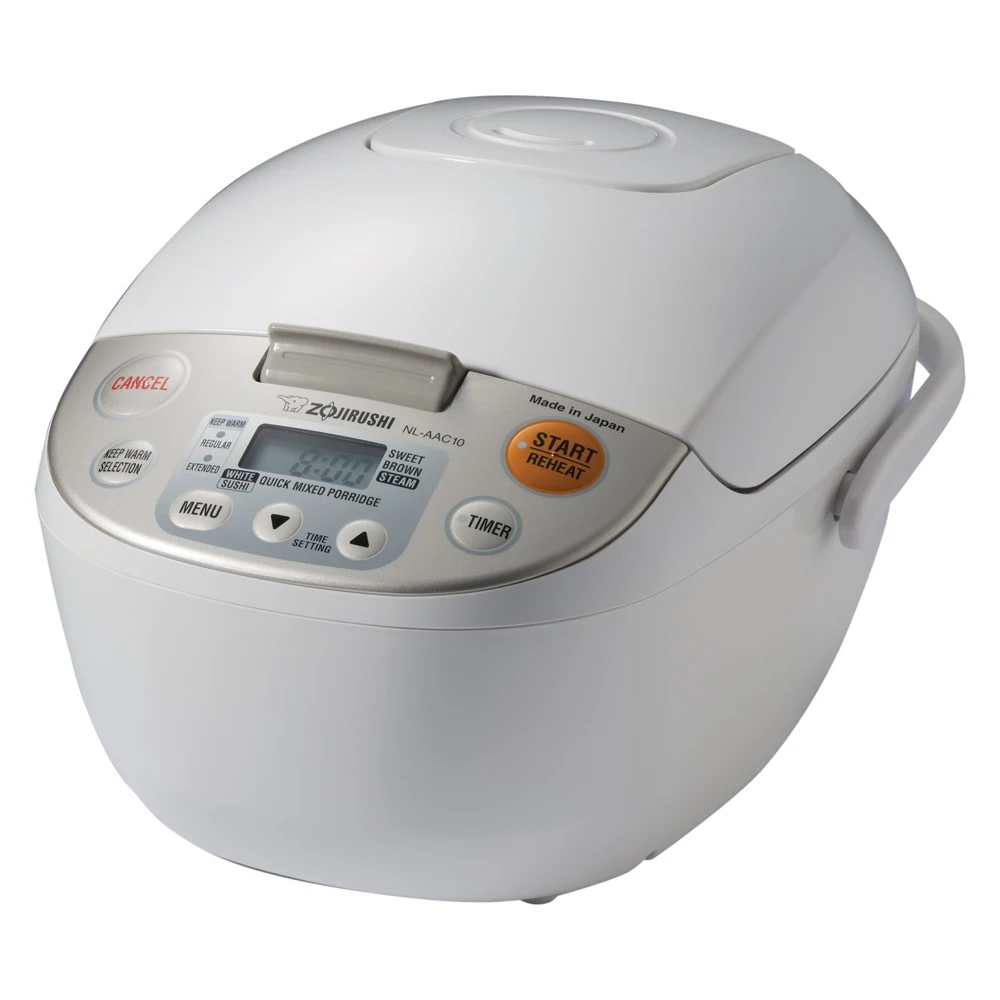
Your needs, this model
Does it fit your priorities?
Can I cook one supplied cup of white rice beneath suitable steaming foods?
Yes. The exact combined White/Sushi method uses one supplied cup on the AAC10. Follow its food and loading instructions.
Explore this need in the finder →Can I put two supplied cups of white rice beneath the basket?
No. Two cups fits its rice-only range but exceeds the combined method’s one-cup limit.
Explore this need in the finder →Does the AAC10 supply a Cake program?
No. Its complete menu lists rice, Steam and Quick, without Cake.
Explore this need in the finder →The NL-AAC10 is a Japan-made microcomputer rice cooker with a supplied steaming basket and a fairly traditional rice menu. Its useful two-level meal is much smaller than its headline rice capacity: the manual permits only one supplied cup of rice beneath the basket. Choose it for that modest combined dinner or for ordinary one-to-five-and-a-half-cup rice meals.
A one-cup meal with a second layer
The included basket and Steam function make steaming a supported use. More specifically, the manual describes cooking suitable foods above rice on White/Sushi. On this smaller configuration, that combined method is limited to one supplied cup of rice. Level the rice and follow the ingredient-placement instructions; a full 5.5-cup rice load is not available underneath a basket of vegetables.
The choice of food matters too. The combined instructions suit foods that need a comparatively long steaming time. A quick-cooking leaf such as spinach is not interchangeable with those foods. You cannot add ingredients during the rice cycle to solve the timing difference. If your usual dinner needs two cups of rice plus a vegetable layer, the larger AAC18 has a different supported combined range.
For a separate Steam session, use its prescribed water and timer routine. Food should not exceed the published approximately 1.5-inch thickness limit. Cut and arrange ingredients so that the lid and steam passage remain clear. Owning a basket is most useful when the food you prepare fits its actual shape and instructions.
Rice capacity without the basket
Ordinary White, Sushi and Quick accept 1–5.5 supplied cups of uncooked rice. Brown, Mixed and Sweet accept 1–4. The supplied cup is approximately 180 mL, smaller than a standard US measuring cup. These quantities describe the dry load, rather than a number of finished bowls. Keep the cup with the appliance so the water markings continue to match the amount you measure.
A one-cup brown-rice supper fits; half a cup does not. Porridge can start at half a cup and reaches 1.5 cups, but that applies to a water-rich rice dish rather than ordinary White. If a half-cup plain-rice meal is your daily routine, compare the smaller LGC05 or a full-size model with an expressly lower minimum.
Know which menu you are buying
The listed selections are White/Sushi, Mixed, Porridge, Sweet, Brown, Steam and Quick. There is no named Jasmine, quinoa, steel cut oatmeal or GABA Brown program, and no Cake selection. Someone buying for a varied breakfast-grain routine should start with a model that names those foods and gives their exact quantities.
The microcomputer adjusts the direct-heating cooking cycle. This is neither an induction model nor a pressure cooker. Its appeal is a familiar rice routine with a real basket, rather than fine feedback-based texture adjustment. The QAC10 combines induction, a tray and named quinoa or oatmeal; the TSC10 adds Cake within a more traditional direct-heating menu.
Serving and care in an ordinary kitchen
Automatic and extended Keep Warm, reheating and two timer settings help organize suitable rice meals. Follow the restrictions for each dish; a combined meal containing other ingredients should not be treated as plain white rice for unattended holding. The completion signal can use a melody or beep. Set the timer around the selected menu's lead time rather than expect every grain to finish equally quickly.
The detachable inner lid, pan and basket need washing after use. Steaming meat or other foods also leaves residue on the lid area, so the convenience of cooking two foods together comes with more than a pan to clean. Protect the nonstick pan with suitable utensils and gentle cleaning. The beige exterior does not describe the pan's material or establish an all-metal food path.
Fit and alternatives
The body measures approximately 10.5 inches wide, 14.625 deep and 8.625 high; the open lid reaches about 16.25 inches. Leave working room to lift out the pan and a clear steam route. Choose the AAC10 for one-cup rice dinners, occasional larger rice-only batches and its carefully limited combined-steaming method. Move to the AAC18 for two-to-four-cup combined meals, or choose a broader grain menu when quinoa and oatmeal are regular requirements.
Sources: Zojirushi US AAC specifications and NL-AAC10/18 instructions.
Key details at a glance
| Capacity and cup basis | Supplied180mL dry cup. White1–5.5, brown1–4; combined White/Sushi1–1. Cooked yield varies. |
|---|---|
| Closed width | 10.5 in |
| Closed depth | 14.62 in |
| Closed height | 8.62 in |
| Heating and controls | direct |
| Delay timer | Yes |
| Automatic Keep Warm | Yes |
| Supplied steaming basket/tray | Yes |
| GABA Brown program | No |
| Pressure-assisted rice cooking | No |
| My Rice feedback adjustment | No |
| Approximate height with lid open | 16.25 in |
| Steam-food height limit | 1.5 in |
| Documented combined rice method | Yes |
| Prescribed Cake program | No |
| Control arrangement | menu |
| Timer arrangement | clock |
Use the exact model’s instructions for operating limits, supplied equipment and version differences.
Sources for this assessment
Put your batch and serving needs together.
Choose the dry amount, grain program and useful accessories.