
On this page
Your needs, this model
Does it fit your priorities?
Does the documented white-rice plan cover six supplied cups, and is seven within its stated ceiling?
The manual table documents white rice from two through six supplied 180 mL cups. Six is the ceiling; seven is outside the listed method. A lower minimum below the first table row is not stated.
Explore this need in the finder →Does the documented brown-rice plan cover six supplied cups?
Yes. Brown rice uses Multigrain in the exact manual, with a table through six supplied cups; the next size is outside the documented rice ceiling.
Explore this need in the finder →Does the manual document a quinoa method, and what is its stated maximum?
Yes. Quinoa appears under Multigrain with a four-supplied-cup maximum. The manual table does not state a lower minimum, so do not treat a specific numerical batch as confirmed.
Explore this need in the finder →What can the Oatmeal program handle?
Oatmeal is a named control and the manual says not to exceed two supplied cups; no separate minimum is stated.
Explore this need in the finder →What is the Porridge batch limit?
Porridge is a named function, with a manual ceiling of one supplied cup. The manual does not give a separate minimum.
Explore this need in the finder →Can rice and tray food cook together at the full six-cup rice setting?
The included tray supports a simultaneous method, but the manual caps rice at four supplied uncooked cups when steaming above it.
Explore this need in the finder →Is induction heating a documented feature, or is this a direct-heated switch cooker?
The exact manufacturer page identifies 360-degree induction with dual temperature sensors; the controls are digital/menu-based.
Explore this need in the finder →Does the delay timer finish the meal at a selected time?
No. The manual describes a countdown after which cooking starts. The delay is fixed/start-delay scheduling, not a finish-by clock.
Explore this need in the finder →Is a separate Steam function documented, and is Soup equally certain?
Steam is shown in the exact-model manual. The current product page lists Soup, but the manual control map and operating list do not show a Soup control; treat a must-have Soup mode as unconfirmed.
Explore this need in the finder →Can the cooker automatically hold a two-cup white-rice batch for thirteen hours?
Automatic Keep Warm is documented, but the manual says food should not remain on Warm beyond twelve hours. Thirteen hours is not supported.
Explore this need in the finder →Will its closed body fit a twelve-inch horizontal opening?
Aroma lists 12 inches as the longer horizontal dimension. Use extra clearance for the open lid and escaping steam; those allowances are not quantified.
Explore this need in the finder →Read “12 cups” as cooked rice, not dry rice
The Aroma ARC-7606B is labeled for 12 cups cooked, or 3 quarts. That is not a twelve-cup dry-rice pot: the model-linked instruction table shows white and brown rice batches from two through six of Aroma’s supplied measures, with six measures yielding about twelve cooked cups. Aroma’s measuring cup is 180 mL (three-quarters of a U.S. cup), so it is also smaller than a kitchen cup. If a recipe or your habit is expressed in standard cups, use the included cup and the cooker’s own water lines rather than treating the numbers as interchangeable.
The manual’s table begins at two supplied cups; it does not state a lower limit for smaller batches. That is a useful boundary if you usually make one small portion: the instructions do not document that quantity, so I would not buy this model on the assumption that a one-cup dry batch is supported. At the upper end, a six-cup uncooked batch gives this 3-quart size room for family meals and planned leftovers without moving into Aroma’s much larger 20-cup-cooked class.
Its reason to stand out is the induction construction
Aroma describes 360-degree induction heating with dual temperature sensors and a heat-retaining stainless-steel inner lid. The supplied inner pot is a two-millimeter heavy-duty iron construction with a nonstick coating. Those are the practical distinctions from a basic bottom-heated switch cooker: this is a digital, menu-selected induction appliance, not a pressure cooker. The manufacturer’s language about even heating is a design claim, not a result established by independent cooking tests here.
The coating matters to ownership. This is not an uncoated stainless-steel cooking pot, and Aroma does not make a complete PFAS/BPA-free statement for every food-contact surface on the product page. The manual recommends hand washing the inner pot to protect its coating; it also permits top-rack dishwasher cleaning with a warning that the finish may discolor. Avoid abrasive pads and utensils that can scratch nonstick surfaces.
Check the grain table, not just the mode names
The documented rice routine uses White Rice for white rice and Multigrain for brown rice and other listed grains. The manual’s rice table gives approximate times of about 35–46 minutes for its two-to-six-cup white-rice rows and about 64–74 minutes for the corresponding brown-rice rows. These are manufacturer estimates, not a promise for every rice variety or kitchen. The grain table also sets different ceilings: three supplied cups for barley, three for bulgur, four for quinoa, and five for couscous. Its oatmeal mode is capped at two cups, while the porridge section says not to make more than one cup. Minimums for those non-rice tables are not separately stated, so a required small-batch quantity should not be assumed.
There is one program-list conflict worth resolving before purchase. The current Aroma product page advertises Soup, while the ARC-7606B manual’s control diagram and operating list show White Rice, Multigrain, Oatmeal, Porridge, and Steam without a Soup control. If a dedicated Soup button is essential, confirm the actual panel and documentation for the exact unit rather than counting the online listing as proof. Steam, by contrast, is explicitly shown in the manual.
The delay is a delayed start, and steaming reduces the rice batch
The delay function lets you load ingredients ahead, but the exact manual describes the cooker starting after the selected countdown; cooking then follows. It is not a finish-by clock. It lists a one-to-fifteen-hour delay for White Rice and Oatmeal, and two to fifteen hours for Multigrain and Porridge. Raw meat should not be left waiting on a delay setting; Aroma cautions against leaving it there for more than two hours.
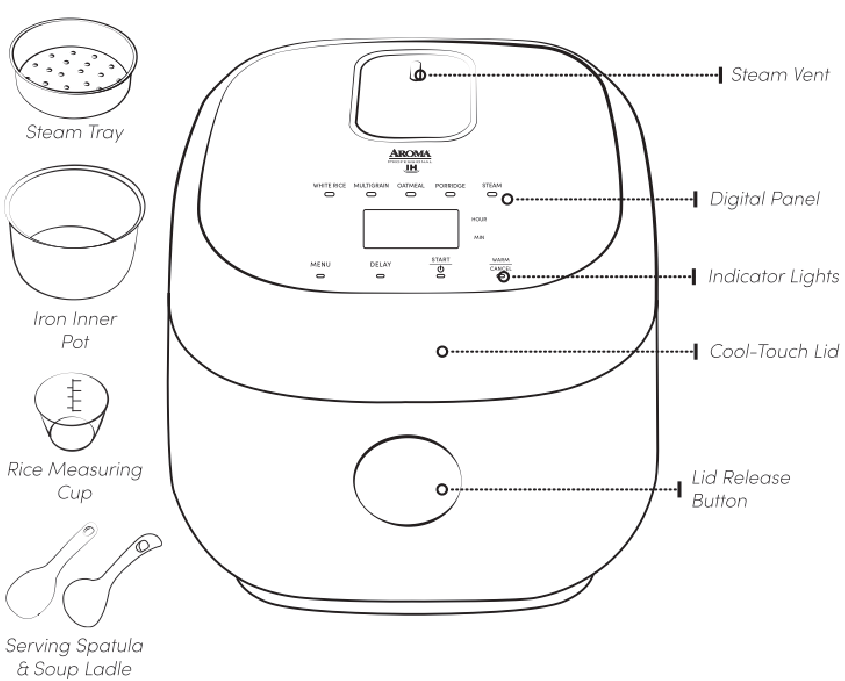
The included steam tray allows food to cook above the rice, but the manual limits a simultaneous rice-and-steam batch to four supplied cups of uncooked rice. That is a meaningful tradeoff: the cooker can take six cups for a rice-only batch, but a five- or six-cup batch does not fit the documented combined method. The manual also advises removing steamed food as soon as it is done, rather than leaving it to overcook while the rice cycle finishes. Its drawing identifies the tray and controls, but it is a labeled manual illustration—not a product photograph or a definitive package checklist.
Allow for a 12-inch countertop span
Aroma lists the closed body at 8.6 inches high by 12 inches long by 10.5 inches wide, weighs it at 10.4 pounds, and rates it for 850 watts at 120 volts. For a narrow shelf, use the longer 12-inch horizontal dimension as the clearance check and leave extra room for the lid and hot steam; the listed closed dimensions do not give a lid-open or steam-clearance measurement. It is more substantial than a small one-button cooker, so count the available landing space before choosing it just for the induction feature.
Who should choose it—and when to compare another size
The ARC-7606B makes most sense when you regularly cook up to six supplied cups of dry rice, want induction heating and digital menus, and will use its tray within the four-cup combined-cooking limit. It is a poor match for a must-have finish timer, an uncoated pot, an essential Soup control that has not been verified, or a routine below the manual’s first documented rice batch.
If you need more dry-rice headroom, compare the Aroma ARC-1290C: its exact instructions cover up to ten supplied cups uncooked and about twenty cooked, while its longer horizontal footprint is 13.43 inches. If smaller batches and a tighter counter matter more, compare a documented four-cup model such as the Aroma ARC-994SG. Those alternatives make the choice less about a generic “best” cooker and more about the batch, counter space, pot surface, and program you will actually use.
Specifications and operating limits are based on Aroma’s ARC-7606B product page and its linked model manual. The image shown with this review is a manual parts illustration, not a product photograph.
Key details at a glance
| Capacity and cup basis | Aroma labels the cooker 12 cups cooked / 3 qt. The model-linked manual table documents white and brown rice batches from 2 to 6 supplied 180 mL measures, with the six-cup row yielding about 12 cooked cups. The table does not state whether smaller-than-two uncooked batches are supported. |
|---|---|
| Closed width | 12 in |
| Closed depth | 10.5 in |
| Closed height | 8.6 in |
| Heating and controls | induction |
| Delay timer | Yes |
More specifications and setup details
| Automatic Keep Warm | Yes |
|---|---|
| Supplied steaming basket/tray | Yes |
| GABA Brown program | No |
| Pressure-assisted rice cooking | No |
| Separate Slow Cook menu | No |
| Documented combined rice method | Yes |
| Prescribed Cake program | No |
| Control arrangement | Menu-based controls |
| Timer arrangement | Fixed delay intervals |
| Manufacturer material disclosure | Aroma describes a 2 mm iron-construction nonstick inner pot. No complete PFAS/BPA-free statement for all food-contact surfaces is established. The manual recommends handwashing; it permits top-rack dishwasher use while warning of possible cosmetic discoloration. |
| Uncoated steel inner cooking pot included | No |
| Separate Steam menu | Yes |
| Separate Multi Cook menu | No |
Use the exact model’s instructions for operating limits, supplied equipment and version differences.
Sources for this assessment

Put your batch and serving needs together.
Choose the dry amount, grain program and useful accessories.